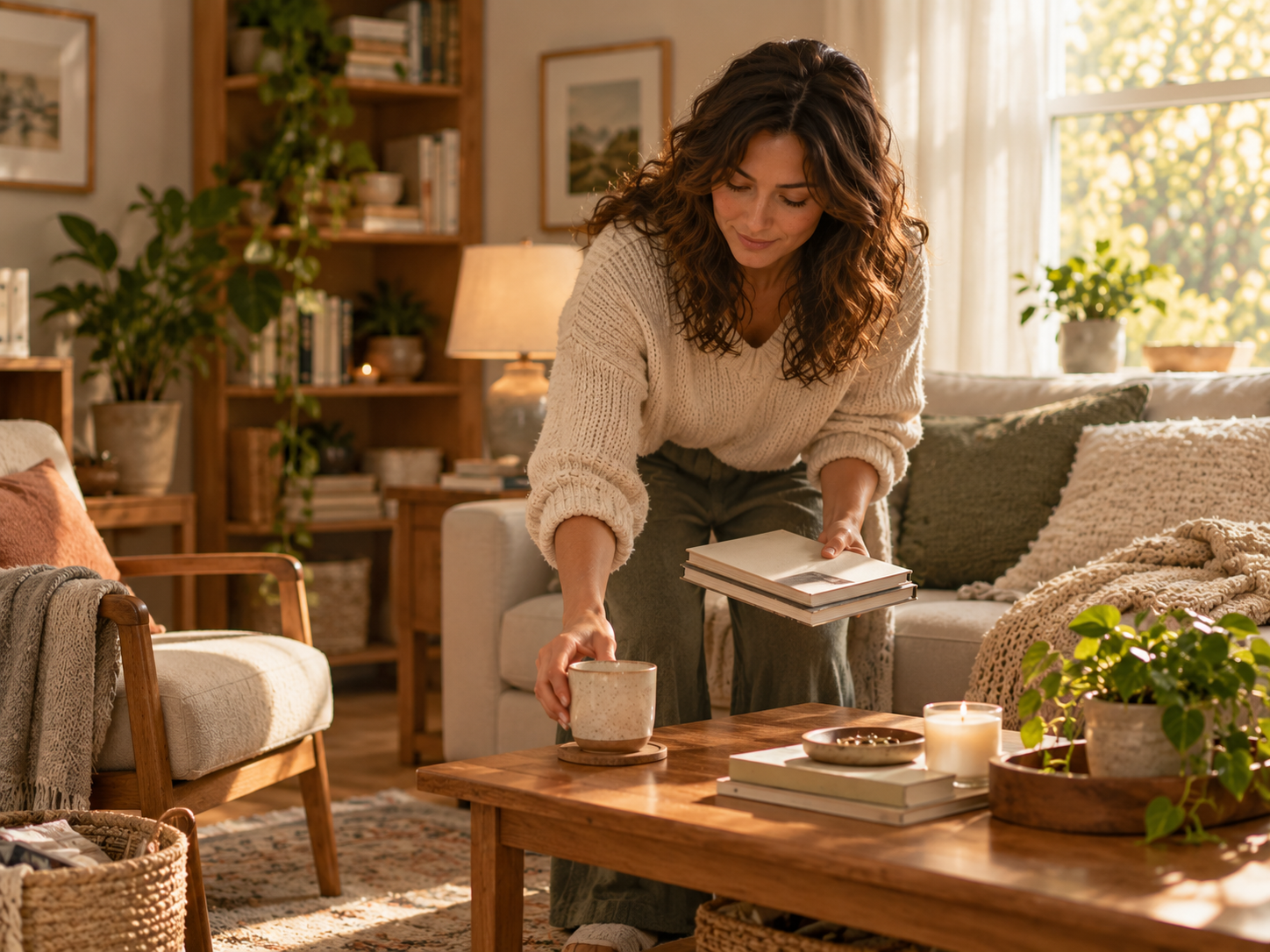
Sometimes a room does not need to be cleaned.
It just feels like too much to deal with right now.
Maybe there is nowhere to put your cup down. A chair has disappeared under clothes. One small area keeps catching your eye every time you pass it.
You do not have to take on the whole room.
For the next five minutes, choose one small spot and make it a little easier to use.
Make the space easier, not finished.
Start Here
Give yourself about five minutes. If a timer helps, set one for five minutes.
Choose one small spot you can reach comfortably.
That spot is the whole job.
It might be:
- one chair
- one small section of a table or counter
- one bedside area
- one small area near the door
Choose somewhere small enough that you can see its edges and that works with your body today.
Your five minutes belong to that spot only.
The timer is a boundary, not a race. Move at a comfortable pace.
Minute 1 — Remove What’s Obvious
Start with only what requires almost no decision.
- Trash
- Empty packaging
- A cup or plate that clearly belongs elsewhere
- Something with an obvious nearby home
If you have to think about it, leave it for later.
Don’t open drawers, start sorting papers, or decide what to keep forever.
Skip anything heavy, sharp, broken, spilled, or otherwise awkward to handle.
No cleaning products are needed for this reset.
Minutes 2–3 — Give the Strays Somewhere to Go
Now look at what is left.
If something has an obvious home nearby, put it there.
If several things belong somewhere else and a bag, basket, or small box is already nearby, you can place them together for later.
Think of it as a temporary landing place, not a new storage system.
Keep it somewhere out of the walkway.
You do not need to solve every object.
You are only making this one spot easier.
Minute 4 — Make One Part Usable Again
Ask one practical question:
What would make this spot easier to use?
Maybe you want enough clear space to set down a mug.
Maybe you want to sit in the chair again.
Maybe you want one small part of the counter back.
You are not decorating.
You are not perfecting.
You are giving the space a little of its function back.
Function before perfection.
Minute 5 — Stop
If there is anything easy left in your chosen spot, use the last minute for that.
When the five minutes end, the reset ends too.
Even if the room is not finished.
Even if there are still things elsewhere that need attention.
Even if you suddenly notice three other places you could work on next.
Those places are not part of this reset.
The room doesn’t have to be finished for the reset to be complete.
That’s enough for now.
You made one part of your home a little easier to use.
You did not finish the whole room.
You were not supposed to.
That’s enough for now.
Why This Can Help
What feels cluttered or demanding varies from person to person. Research has found associations between perceived household clutter and well-being, but that does not mean a cluttered surface causes stress or that everyone should want a minimal home.
This reset makes a smaller promise: one part of your space may simply be easier to use afterward.
It does not need a bigger promise than that.
If the Room Still Feels Like Too Much
You do not have to start another five minutes.
You can leave the rest for later.
If you can, you might move to another room, turn your attention somewhere else, or simply let the unfinished part stay unfinished for now.
A five-minute reset does not need to become a cleaning session unless you choose for it to.
And if today is not a day for another reset, that is useful information too.
Your home does not need to be finished before you are allowed to rest in it.
Continue Gently
If finishing the reset leaves you wanting to rest rather than keep going, try How to Rest When You’re Tired but Still Feel “On”.
If your body feels stiff after sitting, standing, or moving things around, A 5-Minute Gentle Movement Break for Stiff Days may fit better.
Or you can simply stop here.
You do not need to turn one small reset into a productive afternoon.
Sources
Rogers CJ, Hart R. Home and the extended-self: Exploring associations between clutter and wellbeing. Journal of Environmental Psychology. 2021;73:101553.
Quinn F. Home clutter and mental well-being: Exploring moderators and the mediating role of home beauty. Journal of Environmental Psychology. 2025;105:102672.
Leave a Reply