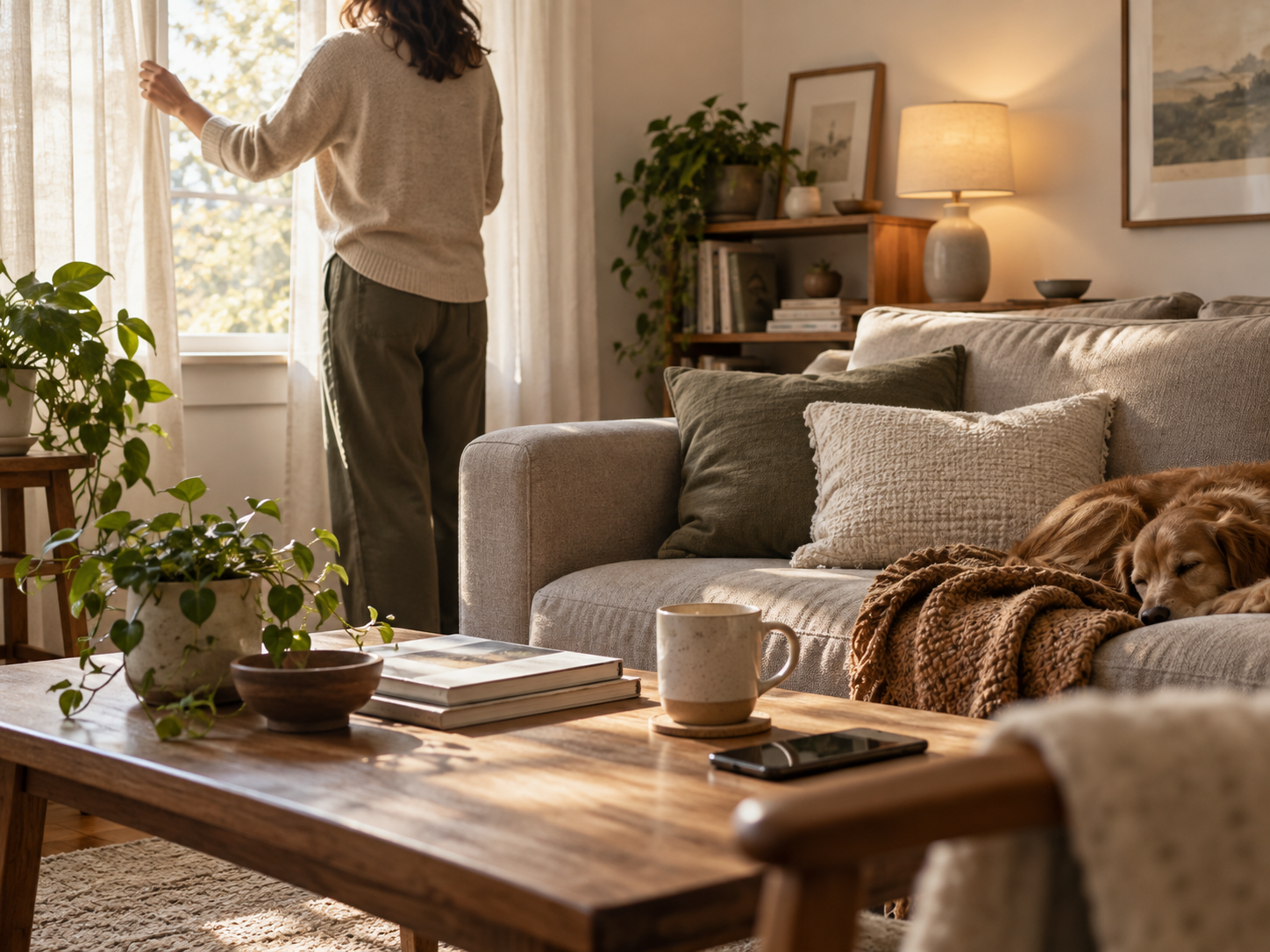
Sometimes a room feels like too much even when nothing is obviously wrong.
The light may feel harsh. Several sounds may be competing. The room may simply feel harder to be in than you would like.
You do not have to redesign the space.
Start by noticing what is asking the most of you.
Soften one input, not the whole room.
Start Here
Pause where you are for a moment.
Instead of asking, “What is wrong with this room?”, try:
“What feels hardest to ignore right now?”
Maybe it is the light, a sound, the temperature, something visually busy, or simply how something feels against your body.
Choose the one that stands out first.
If nothing stands out, you do not need to keep searching.
See whether there is one small, practical way to make that particular thing a little easier.
If something simple — your position, a layer of clothing, or something touching you — is the obvious answer, you can adjust that first.
You may not need anything else from this guide.
You do not need to work through every section below. Go to the one that sounds closest to what you noticed.
If the Light Feels Like Too Much
You do not need perfect lighting.
You may only need less of the light that is bothering you.
If it is practical for what you are doing, try switching off one unnecessary light, adjusting a curtain or blind, moving away from glare, or using another light source that is already available.
You might also discover that you want more light, not less.
Comfort is not always dim.
Keep enough light to move around and do what you are doing safely.
The goal is not to make the room look peaceful.
It is to make seeing and being in it a little more comfortable for you.
If There’s Too Much Sound
Sometimes no single sound is especially loud.
There are just several sounds happening at once — perhaps a television, notifications, an appliance, or noise from elsewhere.
Start with whatever is easiest to change.
Pause something nobody is using. Lower the volume on something you can control. Silence a notification.
Before adding another sound, see whether one can stop first.
You do not have to make the room silent.
You are only looking for a little less competition.
Give Your Eyes Somewhere Quieter to Land
A room does not have to be messy to feel visually busy.
Screens, movement, open storage, or several things in your direct line of sight can all compete for attention.
You do not need to clear the room.
Close a laptop you are not using.
Turn off an unnecessary screen.
Shift your gaze or position toward a part of the room that feels easier to look at.
The goal is not visual perfection. It is somewhere easier for your eyes to land.
Notice Temperature and Air
If the discomfort feels obviously physical — too warm, too cold, or stuffy — adjust what you safely can.
That might mean changing where you are sitting, adding or removing a layer of clothing, or changing the airflow.
If outdoor air quality, weather, and safety allow, you might open a window — or close one if outside conditions are making the room less comfortable.
You do not need ideal conditions.
A small improvement may be enough.
If the heat is extreme, treat it as a heat-safety issue rather than relying on a simple comfort adjustment.
Let Comfort Be Personal
There is no single room that feels comfortable to everyone.
You may like plenty of daylight.
Someone else may prefer softer light.
You may rest best with quiet.
Someone else may find familiar music comfortable.
A room full of books, photographs, and well-loved objects may feel warm and familiar to you. Another person may prefer fewer things in view.
Neither preference is more correct.
The goal is not to make the room look calm. It is to notice what makes it easier for you to be there.
You do not need a label to notice what a room feels like to you.
Don’t Change Everything at Once
When a space feels uncomfortable, it can be tempting to start adjusting everything.
The light changes, the window opens, the fan goes on, things get moved — and suddenly making the room easier has become another project.
Try one change first.
Then notice:
Is this a little better, worse, or about the same?
You do not have to analyze the answer.
If the change helps, you may already be done.
If it does not, you can undo it or try one other thing.
Make the room ask a little less of you — without turning comfort into another task.
Why This Can Help
Features of indoor spaces — including lighting, temperature, and environmental noise — have been studied in relation to comfort, health, and well-being.
But the strength of the evidence varies, and what feels comfortable can differ from person to person.
There is no single combination that makes a room feel right for everyone.
This guide makes a smaller promise:
Changing one thing may make the room a little more comfortable for you right now.
If the Room Still Feels Like Too Much
Sometimes the thing bothering you is not easy to change.
The noise may come from outside.
You may share the space.
You may not control the temperature.
You may not have another room to go to.
You may simply not have the energy to change anything right now.
None of that means you need to keep working on the room.
If you can, move somewhere that feels easier for a while — or leave the adjustment for another time.
And sometimes the useful thing is simply noticing:
“This room is not very comfortable for me right now.”
You do not have to solve that observation immediately.
Continue Gently
If one visually busy area is also making the room harder to use, When a Room Feels Like Too Much: A 5-Minute Reset may fit better.
If the room feels good enough and what you need now is rest, try How to Rest When You’re Tired but Still Feel “On”.
Or stay exactly where you are with the one small adjustment you already made.
You do not need to keep improving the room once it feels good enough for now.
Sources
Osibona O, Solomon BD, Fecht D. Lighting in the Home and Health: A Systematic Review. International Journal of Environmental Research and Public Health. 2021;18(2):609.
Grocott K, Mansour A, Shiels E, Bentley R, Mason K. Mental Health Effects of Exposure to Environmental Noise at Home: A Systematic Review of Potential Mediating Pathways. Noise & Health. 2025;27(126):255–267.
Arsad FS, Hod R, Ahmad N, Baharom M, Ja’afar MH. Assessment of Indoor Thermal Comfort Temperature and Related Behavioural Adaptations: A Systematic Review. Environmental Science and Pollution Research. 2023;30:73137–73149.